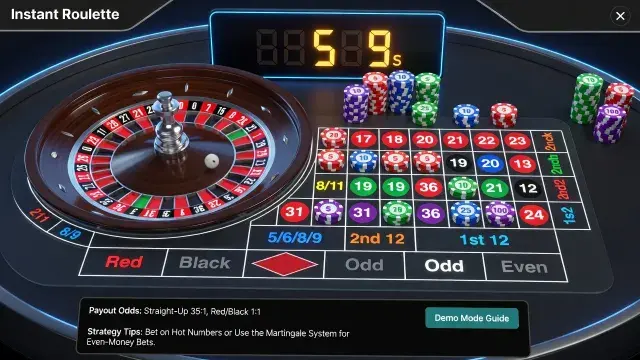
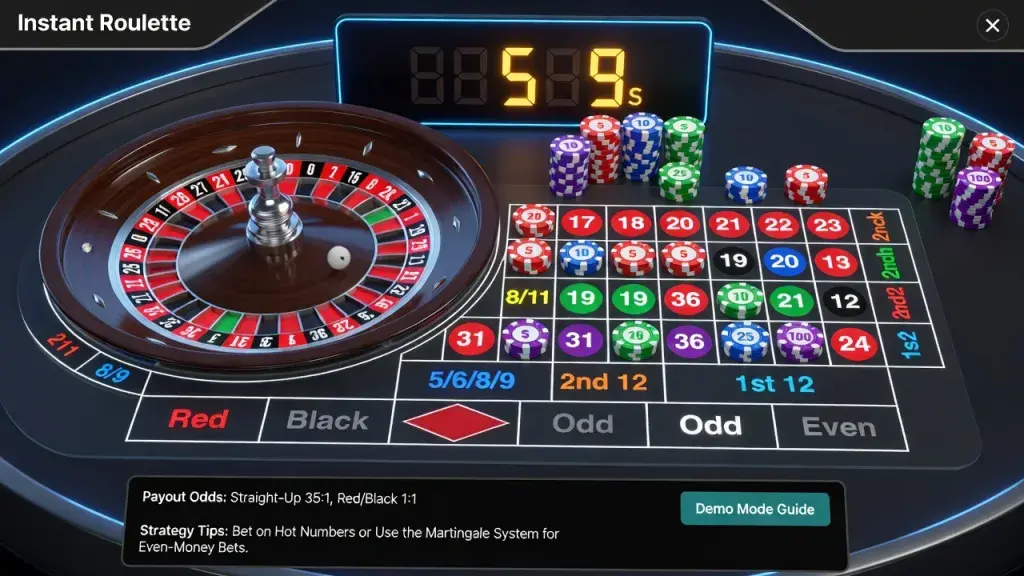
A ball drops roughly every few seconds in Instant Roulette, not every minute or two like in a standard live table. That single design choice changes everything about how the game feels, how fast money moves, and how a player should approach betting decisions. Where traditional roulette gives you time to think, chat with a dealer, and watch other players place chips, Instant Roulette strips away the waiting and delivers a continuous stream of results generated by an automated wheel with no live dealer at all.
This format has grown popular precisely because it removes friction. There's no queue for a seat, no pause between spins while a croupier collects chips, and no need to wait for other players to finish betting. If you're new to the format and want a structured walkthrough before risking real money, a solid resource on how to play instant roulette can save you from the early mistakes most beginners make. Understanding the mechanics before the first spin matters more here than in slower game formats, because the pace leaves little room for hesitation once you're in.
What follows is a complete breakdown: the rules that govern the wheel, the exact steps for playing online, strategic approaches worth considering, the payout structure and true odds behind each bet, and how to use demo mode to build confidence before committing real funds.
Understanding Instant Roulette Game Rules
How the Wheel and RNG Work Together
Instant Roulette typically runs on a physical wheel filmed by cameras, with results captured and fed into the platform in real time, or on a fully digital wheel driven by a random number generator. Either way, the defining trait is speed. There's no dealer spinning the wheel on command and no delay for chip clearing. As soon as one result registers, a new betting round opens automatically. The instant roulette game rules are built around this rapid cycle: a short betting window, an automatic close, a result, and payout, all within seconds.
Standard Roulette Numbers and Layout
The betting layout mirrors classic European roulette in most versions, with numbers 0 through 36 and the usual color distribution of red and black. Some variants use an American-style double-zero wheel, which raises the house edge, so checking which wheel type a platform uses before playing is worth the extra thirty seconds. The betting grid includes single numbers, splits, corners, streets, columns, dozens, and the outside bets like red/black, odd/even, and high/low.
Betting Windows and Round Timing
Because rounds move quickly, the betting window is short, often just a handful of seconds. Miss the window and your bet simply doesn't register for that round. This is the single biggest adjustment new players need to make: decisions have to be made in advance, not improvised mid-round. Reading the countdown timer becomes as important as reading the numbers themselves.
How to Play Instant Roulette Online: Step-by-Step
Creating an Account and Accessing the Game
Getting started follows the same basic pattern across most platforms offering instant roulette online: register an account, verify identity if required, and deposit funds through an accepted payment method. Once inside the lobby, Instant Roulette usually sits in a dedicated "instant games" or "live casino" category, distinguishable from standard roulette by its continuous, dealer-free format.
Placing Your First Bet
The interface displays the betting table, a countdown clock, and a running history of recent results. Selecting a chip value and clicking or tapping the desired bet area places the wager. Multiple bets can be stacked in a single round, covering several numbers or combining inside and outside bets simultaneously. Once the timer hits zero, betting locks automatically and the result appears within seconds.
Reading Results and Collecting Payouts
Winnings are credited automatically the moment a round resolves, with no manual claim process. The result history panel, usually showing the last 20 to 50 outcomes, gives a quick visual reference for patterns players may want to track, even though each spin remains statistically independent of the last.
- Register and fund your account
- Locate Instant Roulette in the live or instant games section
- Select chip value and place bets before the timer expires
- Wait for the automatic result and payout
- Review the history panel to inform future bets
Instant Roulette Strategy Tips
Bankroll Management for Rapid-Fire Rounds
The speed of Instant Roulette is its biggest risk factor. Because rounds resolve so quickly, losses can accumulate faster than in traditional roulette simply due to volume. Setting a fixed session budget and a per-round bet limit before playing is not optional advice here, it's a practical necessity. Deciding in advance how many rounds you'll play, rather than how much time you'll spend, tends to work better given the pace.
Outside Bets vs. Inside Bets
Outside bets like red/black or odd/even pay even money and cover close to half the wheel, making them the lower-variance choice for players who want longer sessions with smaller swings. Inside bets, such as straight-up numbers, pay far more but hit far less often. Among instant roulette strategy tips worth taking seriously, balancing a base of outside bets with occasional inside bets for upside is one of the more sustainable approaches, since it controls variance while leaving room for larger wins.
Progressive Betting Systems: What Actually Works
Systems like Martingale (doubling after a loss) or Fibonacci sequences are popular but don't change the underlying house edge. They can smooth short-term results or extend a session, but they also carry real risk of hitting table limits or exhausting a bankroll during a losing streak. Treat these systems as bankroll management tools, not as a way to beat the math of the wheel.
Avoiding the Speed Trap
The fast pace of Instant Roulette encourages impulsive betting. Players who succeed longest tend to set a rhythm, betting every second or third round rather than every single one, giving themselves a moment to assess bankroll and stay deliberate rather than reactive.
Instant Roulette Payout and Odds Explained
Payout Table by Bet Type
The payout structure mirrors standard roulette conventions closely. A straight-up bet on a single number pays 35 to 1. Split bets pay 17 to 1, street bets 11 to 1, corner bets 8 to 1, and six-line bets 5 to 1. Column and dozen bets pay 2 to 1, while even-money bets like red/black, odd/even, and high/low pay 1 to 1.
- Straight-up (single number): 35 to 1
- Split (two numbers): 17 to 1
- Street (three numbers): 11 to 1
- Corner (four numbers): 8 to 1
- Six-line (six numbers): 5 to 1
- Column or dozen: 2 to 1
- Red/black, odd/even, high/low: 1 to 1
House Edge and Probability
On a European single-zero wheel, the house edge sits at approximately 2.7% across nearly all bet types, since the payout odds are set slightly below the true mathematical odds to account for the zero. On an American double-zero wheel, that edge roughly doubles to about 5.26%. This is the core of instant roulette payout and odds: no single bet type offers better long-term value than another on the same wheel, since the house edge is baked uniformly into the payout table.
Why Volume Changes the Math for Players
Because Instant Roulette delivers far more rounds per hour than a live dealer table, the same house edge percentage translates into faster expected losses (or gains) over a session. A 2.7% edge applied across sixty rounds an hour behaves very differently in practice than the same edge across fifteen rounds an hour on a traditional table. This is the mathematical reason bankroll discipline matters more in fast formats than in slower ones.
Using Instant Roulette Demo Mode Effectively
What Demo Mode Actually Offers
Most platforms that host Instant Roulette provide a free-play version funded with virtual credits. Instant roulette demo mode replicates the real game's interface, timing, and payout structure exactly, without any financial risk. It's the fastest way to learn the rhythm of the betting window before real money is on the table.
Practicing Bet Placement and Timing
New players should use demo mode specifically to practice the mechanical side: selecting chip values quickly, stacking multiple bets, and reacting to the countdown without feeling rushed. Because the pace is the biggest adjustment from traditional roulette, repetition in a risk-free environment builds the muscle memory that pays off once real stakes are involved.
Testing Strategies Before Committing Funds
Demo mode is also the right place to test progressive betting systems or bet-balancing approaches discussed earlier. Running a Martingale sequence through fifty rounds of free play reveals how quickly bet sizes escalate during a losing streak, a lesson far cheaper to learn with virtual chips than real ones.
Frequently Asked Questions
Is Instant Roulette fair, given there's no visible dealer spinning the wheel?
Reputable platforms use certified random number generators or camera-verified physical wheels audited by independent testing agencies. The absence of a live dealer doesn't inherently reduce fairness; the outcome is still governed by the same mathematical principles as any roulette wheel, and licensed operators are required to publish or make available their auditing certificates.
Can I switch between demo mode and real-money play on the same platform?
Most platforms allow toggling between the two modes from the same game lobby, provided you're logged into an account. Balances are kept separate, so virtual credits used in demo mode never mix with real funds.
Why do rounds close so quickly compared to regular online roulette?
Instant Roulette is designed to maximize the number of rounds per hour by removing the pauses associated with live dealer interaction, chip collection, and player chat. The short betting window is intentional, aimed at players who prefer rapid decision-making over the slower pace of a traditional live table.
Do progressive betting systems like Martingale actually reduce the house edge?
No. These systems change the size and timing of bets but don't alter the fixed house edge built into the payout table. They can produce short streaks of recovered losses but carry meaningful risk of larger losses during extended losing runs, particularly given how many rounds occur per hour in this format.
What's the safest bet type for a beginner trying Instant Roulette for the first time?
Even-money outside bets such as red/black or odd/even offer the lowest variance, paying 1 to 1 with close to a 50% chance of winning on a European wheel. They won't produce large payouts, but they allow beginners to experience many rounds without rapid bankroll depletion while they learn the pacing.
How much should I budget for a typical Instant Roulette session?
A workable approach is to set a fixed loss limit equal to an amount you're fully comfortable losing, then divide it into per-round bet sizes based on how many rounds you intend to play. Given the speed of the format, a session budget defined by number of rounds tends to be more controllable than one defined by clock time.