A single round of speed roulette can conclude in under twenty seconds, faster than the time it takes to read this sentence twice. That pace changes everything about how a player should approach the wheel. Traditional roulette rewards patience and reflection between spins; speed variants punish hesitation and demand a plan that works under pressure. The rise of automated tables and rapid-fire formats has quietly rewritten the rules of engagement for anyone who plays roulette online.
Casinos didn't simply speed up the wheel for novelty. Auto roulette tables, which remove the human dealer and run on mechanical or electronic spin mechanisms, allow far more rounds per hour than a staffed table ever could. For players, this means more decisions, more exposure to variance, and less time to recalculate a wager between spins. Anyone who has tried a speed auto roulette strategy knows the format rewards preparation over improvisation, since the compressed timing leaves little room for on-the-fly recalculation. Understanding how these systems operate - and how to adapt a workable roulette betting strategy to their rhythm - separates players who last through a session from those who burn through a bankroll in minutes.
This piece breaks down how auto roulette systems function, what changes when speed becomes the defining feature of a game, and which betting frameworks hold up under rapid conditions. The aim is practical clarity: what works, what doesn't, and why.
Understanding Auto Roulette Systems
How Automated Wheels Differ From Live Tables
An auto roulette system replaces the human croupier with a mechanical spinning mechanism, sensors, and software that reads the ball's landing position and settles bets automatically. The wheel itself follows identical physics to a standard roulette wheel - same pocket layout, same house edge based on single-zero or double-zero configuration. What changes is the interval between spins. A live dealer needs time to collect chips, pay winners, and spin the wheel by hand. Automation strips out that downtime, compressing what might be a ninety-second cycle into thirty seconds or less.
Why Speed Changes the Player Experience
Faster spins mean faster bankroll turnover. A player who wagers the same amount per spin in an auto game will place roughly twice as many bets per hour compared to a slower live table. This accelerates both potential losses and potential wins, which is precisely why bankroll discipline matters more here than in almost any other casino format. The psychological experience also shifts: rapid rounds create a rhythm that can pull players into betting reflexively rather than deliberately.
Technical Features Worth Knowing
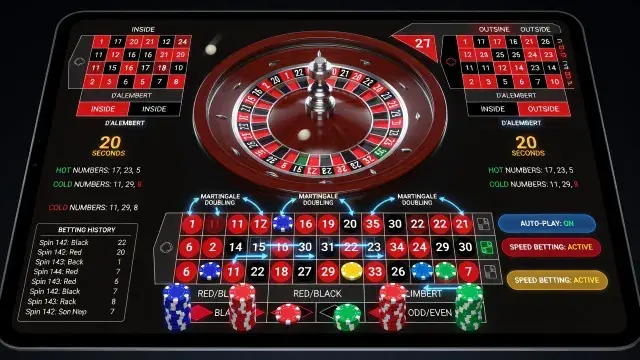
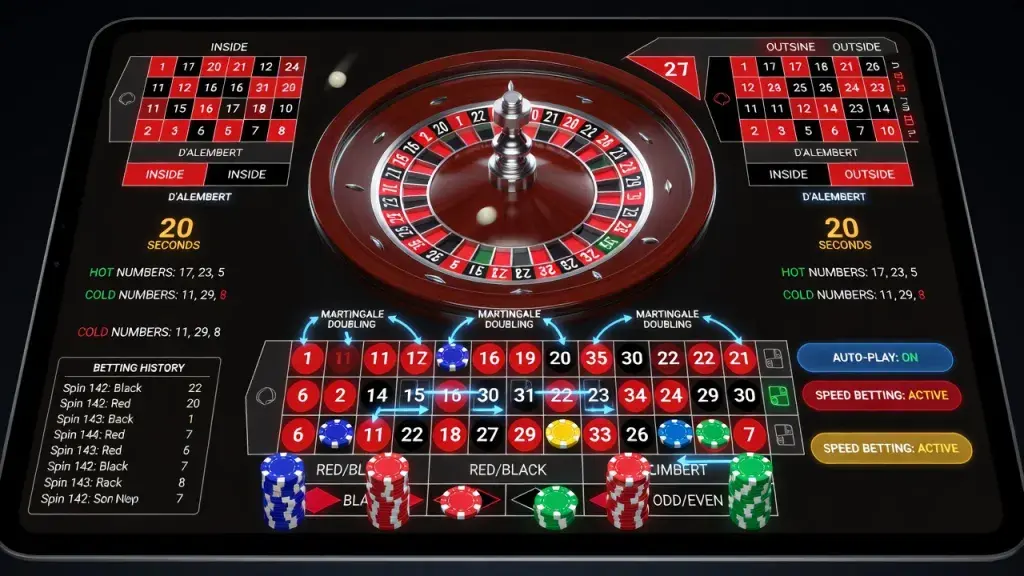
Most auto roulette tables display betting history, hot and cold numbers, and countdown timers directly on screen. These features exist to help players track patterns, though they don't alter the underlying probability of any given spin. Recognizing this distinction is fundamental to using an auto roulette system without falling into the trap of chasing patterns that carry no predictive weight.
Core Principles of a Sound Roulette Betting Strategy
Bankroll Management as the Foundation
No roulette betting strategy survives contact with a depleted bankroll. Setting a fixed session budget, dividing it into unit sizes, and defining a stop-loss threshold before play begins are non-negotiable steps. A common approach is wagering no more than one to two percent of a session bankroll per spin, which allows for extended play even through a losing streak.
Understanding House Edge and Bet Types
Every roulette bet carries a fixed house edge determined by wheel type. Single-zero wheels give the house roughly a 2.7 percent edge; double-zero wheels push that closer to 5.26 percent. Outside bets - red/black, odd/even, high/low - pay even money and offer close to a 48.6 percent win probability on a single-zero wheel. Inside bets, like straight-up numbers, pay 35 to 1 but hit far less often. A sound strategy matches bet selection to risk tolerance rather than chasing the largest possible payout.
Common Betting Systems and Their Limits
- Martingale: doubling the bet after each loss, designed to recover losses with a single win, but vulnerable to table limits and long losing streaks.
- Fibonacci: increasing bets according to the Fibonacci sequence, offering a gentler progression than Martingale.
- D'Alembert: raising or lowering bets by one unit depending on win or loss, favored for its lower volatility.
- Flat betting: wagering the same amount regardless of outcome, prioritizing bankroll longevity over recovery speed.
None of these systems change the house edge. They only alter how quickly a bankroll rises or falls, which matters enormously once speed enters the equation.
Fast Roulette Strategy: Adapting to Rapid Play
Why Traditional Systems Need Adjustment
A fast roulette strategy can't rely on the same pacing assumptions as a leisurely live-dealer game. Progressive systems like Martingale escalate bet sizes with each loss, and in a rapid environment, several losing spins can occur within minutes rather than across an entire session. Players need tighter stop-loss triggers and smaller starting units to account for the compressed timeline.
Simplified Decision-Making Under Time Pressure
Speed formats leave little room for complex calculations between spins. Effective players pre-select a small set of bets - perhaps a combination of an outside bet and one or two inside numbers - and stick to that combination for the entire session rather than improvising new patterns each round. This reduces decision fatigue and keeps betting consistent even as the pace accelerates.
Setting Time-Based Limits, Not Just Money Limits
Because rapid tables allow far more spins per hour, a purely financial stop-loss may trigger too late to prevent significant damage. Pairing a monetary limit with a time limit - for instance, capping a session at twenty minutes regardless of outcome - helps maintain control when the wheel is spinning every few seconds.
Roulette Speed Betting: Managing Risk in Real Time
The Psychology of Rapid-Fire Wagering
Roulette speed betting compresses emotional highs and lows into a short window. Wins feel more frequent because they arrive faster, which can create a false sense of momentum. Losses stack quickly too, and the temptation to "catch up" within the same session is stronger than in slower formats. Recognizing this emotional acceleration is as important as any numerical system.
Practical Techniques for Staying Disciplined
- Pre-commit to a fixed number of spins per session rather than playing until a feeling of "enough" arrives.
- Use auto-play features with pre-set loss limits, where available, to remove impulsive mid-session adjustments.
- Track results in a simple tally rather than relying on memory, since rapid spins blur outcomes quickly.
Balancing Speed With Bet Size
Smaller bet sizes relative to bankroll compensate for the higher volume of spins in speed formats. A player who would comfortably wager a larger unit at a slower table should scale down proportionally when moving to rapid or auto tables, simply because more spins mean more variance exposure per hour.
Building an Effective Online Roulette Strategy
Choosing the Right Table Format
Not every online roulette strategy suits every table type. Standard live tables suit players who want time to think between bets. Auto and speed tables suit those comfortable with faster pacing and tighter discipline. Matching personal temperament to table format is often more decisive than any specific betting system.
Combining Bet Types for Balanced Exposure
Many experienced players blend outside bets, which offer steadier but smaller returns, with occasional inside bets for higher-payout variance. This blended approach smooths out the bankroll curve compared to betting exclusively on high-payout numbers.
Tracking Performance Across Sessions
Keeping a simple record of session length, starting bankroll, ending bankroll, and bet types used reveals patterns over time that memory alone won't capture. This record-keeping habit turns scattered play into a genuine strategy that can be refined session after session.
Common Mistakes to Avoid
Chasing Losses Under Time Pressure
The single most damaging habit in any fast-paced format is increasing bet size to recover losses within the same session. This impulse feels logical in the moment but ignores the fact that each spin remains statistically independent of the last.
Ignoring Table Limits
Progressive systems like Martingale require a bet ceiling far above the table maximum to function as designed. Auto and speed tables often carry lower maximum limits than premium live tables, which can cap a progression system before it has a chance to recover.
Overestimating Pattern Recognition
Hot and cold number displays on auto roulette screens show historical results, not future probabilities. Treating recent outcomes as predictive of what comes next is one of the most persistent errors among players new to these formats.
Frequently Asked Questions
Is an auto roulette system fair compared to a live dealer table?
Yes, auto roulette systems use certified random number generation or sensor-based physical wheels that follow the same probability rules as live tables. The mechanism differs, but the odds for each bet type remain identical.
Can a fast roulette strategy actually reduce losses?
A fast roulette strategy won't change the house edge, but it can reduce the rate at which losses accumulate by enforcing smaller bet units and stricter time-based limits suited to rapid play. The value lies in discipline, not in beating the math.
How much bankroll should I set aside for roulette speed betting?
Because speed formats generate significantly more spins per hour, allocate a bankroll you're fully prepared to lose within a short window, typically smaller per-session amounts than you'd bring to a slower live table. Dividing that bankroll into small units per spin extends playable time.
Are progressive betting systems like Martingale suitable for auto roulette?
Progressive systems can work in short bursts but carry real risk in fast formats, since losing streaks compound quickly within a compressed timeframe. Lower table limits on many auto tables also restrict how far a progression can climb before hitting a ceiling.
What's the biggest difference between playing online versus at a physical roulette table?
Online play, especially through auto and speed formats, offers far more spins per hour and removes the natural pauses a live dealer creates. This makes a disciplined online roulette strategy with clear time and money limits more essential than in a physical casino setting.
Does watching previous spin results help predict the next outcome?
No, each spin is an independent event regardless of what came before. Displayed statistics are useful for tracking session history but carry no predictive value for the next result.