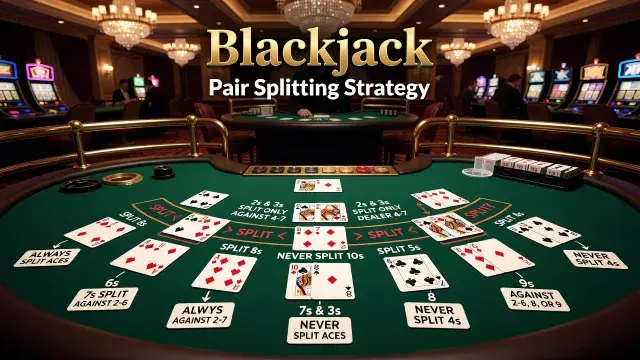
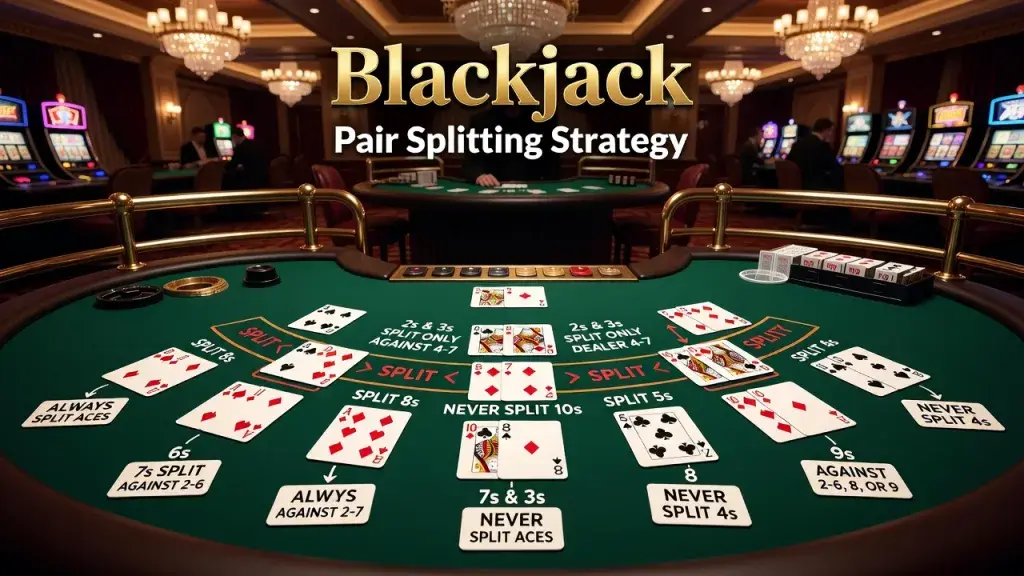
A pair of 8s against a dealer's 10 looks like a disaster waiting to happen - and it is. But basic strategy still tells you to split it. That single decision, counterintuitive as it seems, separates players who understand blackjack mathematics from those who play on instinct. Splitting pairs is where blackjack stops being a game of gut feeling and becomes an exercise in probability.
Most players at a blackjack table treat pair splitting as an occasional bonus move, something to try when they feel lucky. That approach costs money over time. The decision to split is governed by fixed rules derived from millions of simulated hands, and deviating from them - in either direction - shifts the house edge back in the casino's favor. If you want a definitive answer on which pairs to split in blackjack, the short version is that some splits are automatic, some depend entirely on the dealer's upcard, and a few pairs should never be split at all.
This piece breaks down the logic behind every splitting decision, walks through the optimal pair splitting chart hand by hand, and explains the rule variations that change the math at different tables. By the end, you'll have a working blackjack splitting strategy you can apply at any table without hesitation.
Understanding the Basics of Pair Splitting
What Counts as a Splittable Pair
A splittable pair requires two cards of identical rank - two 7s, two Kings, two Aces. Rank matters, not suit or value grouping. A 10 and a King are both worth ten points, but they are not a pair in the eyes of splitting rules at most tables, since they carry different ranks. Some casinos allow "any two ten-value cards" to be split, but this is a house-specific exception, not the default rule, so always check table signage or ask the dealer before assuming.
How Splitting Changes the Hand
When you split, your original two cards separate into two independent hands, each requiring an additional bet equal to your original wager. You then play each hand out separately, drawing cards as needed, and the dealer settles each one against their final hand independently. This means a single split can double your action and, when done at the right moment, double your expected profit. Done at the wrong moment, it doubles your loss just as efficiently.
Why the Dealer's Upcard Drives the Decision
Every splitting decision hinges on one variable above all others: the dealer's upcard. A pair that's a clear split against a 6 might be a clear stand against a 9. This is because the dealer's upcard tells you the probability of them busting or making a strong hand. Weak upcards (4, 5, 6) mean the dealer busts more often; strong upcards (9, 10, Ace) mean the opposite. Blackjack pair splitting rules are built entirely around this relationship.
Which Pairs to Split in Blackjack: The Core Rules
Always Split: Aces and 8s
Two rules in blackjack strategy are treated as near-universal law: always split Aces, and always split 8s. A pair of Aces splits into two hands each starting at 11 - arguably the best possible starting point in the game. A pair of 8s totals 16, the worst hand in blackjack to stand or hit with. Splitting turns one terrible 16 into two hands starting at 8, which have far better prospects than a static 16 against almost any dealer card.
Never Split: 10s, 5s, and 4s
Some pairs should stay intact regardless of what the dealer shows. A pair of 10-value cards totals 20 - one of the strongest hands available. Splitting it throws away a near-certain win for two uncertain hands starting at 10. A pair of 5s totals 10, an excellent doubling opportunity; splitting turns that into two weak hands starting at 5. A pair of 4s totals 8, a marginal hand better left alone or occasionally doubled, never split, since two hands of 4 rarely improve your position.
Situational Pairs: 2s, 3s, 6s, 7s, and 9s
These pairs form the heart of blackjack splitting strategy because their correct play depends entirely on the dealer's upcard.
- 2s and 3s: split against dealer 4 through 7, otherwise hit
- 6s: split against dealer 2 through 6, otherwise hit
- 7s: split against dealer 2 through 7, otherwise hit or stand depending on total
- 9s: split against dealer 2 through 6, 8, or 9, stand against 7, 10, or Ace
These are not arbitrary cutoffs. They reflect the exact point where the dealer's bust probability makes splitting more profitable than standing or hitting.
Optimal Pair Splitting Chart Explained
How to Read a Splitting Chart
A standard optimal pair splitting chart lists player pairs down the left column and dealer upcards across the top row, with each intersection marked as split, hit, stand, or double. The chart assumes standard rules - typically a dealer standing on soft 17, four to eight decks, and double after split allowed. If your table varies these conditions, the correct decision at a few borderline intersections can shift.
Reading the Chart in Practice
Take a pair of 9s against a dealer's 7. The chart says stand, not split, because the dealer's 7 is strong enough that splitting into two hands starting at 9 doesn't beat standing on 18. Change the dealer's card to a 6, and the chart flips to split, since a 6 is a bust-prone card and two hands starting at 9 will likely outperform standing on 18 against a weaker dealer position. This single-card difference illustrates why memorizing the chart, rather than guessing by feel, is essential.
Common Chart Misreadings
Players frequently confuse pairs of 7s with pairs of 9s, applying the same cutoff to both. They also tend to forget that Aces and 8s are always split regardless of the dealer's card, second-guessing the chart when a dealer shows a strong Ace or 10. Trusting the chart over intuition is the entire point of using one.
When to Split Pairs in Blackjack Under Different Rule Sets
Double After Split (DAS) Rules
When a casino allows doubling after splitting, several borderline pairs become more profitable to split because you gain the option to double one of the resulting hands if it draws favorably. Under DAS, splitting 6s and 7s against slightly stronger dealer cards becomes correct, where it wouldn't be under no-DAS rules. Always confirm whether your table permits this before applying chart decisions rigidly.
Resplitting Limits
Most tables allow resplitting, meaning if you split a pair and draw another matching card, you can split again - sometimes up to three or four hands total. Some casinos cap resplitting at one additional split, or disallow it entirely for Aces. This matters most for pairs like 8s and Aces, which you'll want to resplit whenever the rules allow, since the underlying math favoring the original split still applies.
Number of Decks and Its Effect
Single-deck and double-deck games shift the odds slightly compared to six- or eight-deck shoes, because card removal has a larger proportional effect. A detailed breakdown of which pairs to split in blackjack under different deck counts is available at which pairs to split in blackjack, which covers deck-specific adjustments in more depth than a general chart can. In practice, the differences are small enough that a standard multi-deck chart works well at most commercial tables.
Common Mistakes When Splitting Pairs
Splitting Out of Emotion
Players often split 10s because "it feels aggressive" or refuse to split 8s against a strong dealer card because it "feels like throwing money away." Both instincts are wrong. The math behind splitting doesn't care how a decision feels in the moment; it cares about long-run expected value across thousands of repetitions.
Ignoring the Dealer's Upcard Entirely
Some players apply a fixed rule - "always split 9s" or "never split anything above 8s" - without checking the dealer's card at all. This guarantees mistakes on situational pairs like 2s, 3s, 6s, and 9s, where the correct play flips depending on what the dealer shows.
Overspending on Multiple Splits
Resplitting Aces or 8s repeatedly can multiply your bet size quickly. This is mathematically sound when the rules support it, but players need enough bankroll depth to sustain three or four simultaneous hands. Splitting correctly but running out of chips mid-hand defeats the purpose entirely.
Building a Practical Splitting Strategy at the Table
Memorization Techniques
Rather than memorizing the entire chart at once, group pairs into three categories: always split, never split, and situational. This cuts the memorization load roughly in half, since only five pairs - 2s, 3s, 6s, 7s, and 9s - require dealer-card-specific decisions.
Practicing Before Playing for Real Money
Free online blackjack trainers let you drill splitting decisions repeatedly until the correct play becomes automatic. This matters more than it sounds, because hesitating at a live table under time pressure often leads to reverting to instinct rather than strategy.
Adjusting for Table-Specific Rules
Before sitting down, check the table's posted rules for double-after-split availability, resplitting limits, and deck count. A blackjack splitting strategy that works perfectly at one casino can be slightly off at another if these conditions differ.
Frequently Asked Questions
Should I ever split a pair of 10s if I'm counting cards?
No. Even in favorable counting situations, splitting 10s remains incorrect because standing on 20 already carries near-maximum win probability. Card counting affects betting size and occasional deviations elsewhere on the chart, but it doesn't override the mathematical strength of a 20.
What happens if I split and get another matching card?
If resplitting is allowed at your table, you can split again, creating a third hand. If it's not allowed, you simply play that hand as a normal two-card hand and continue drawing as needed.
Does splitting Aces always give you a blackjack payout if I draw a 10?
No. Most casinos pay drawing a 10-value card after splitting Aces as a regular 21, not a blackjack, meaning it pays even money rather than the usual 3:2 bonus. This rule reduces the overall value of splitting Aces slightly, though it remains correct play.
Is it ever correct to split a pair against a dealer's Ace?
Rarely. Aces and 8s are the main exceptions, since they're split regardless of the dealer's card. Nearly every other pair should be hit or stood against a dealer Ace, since the dealer's strong position outweighs the benefit of splitting.
Can casino-specific side rules change basic pair splitting strategy?
Yes. Rules like double-after-split, resplit limits, and dealer standing on soft or hard 17 all shift a handful of borderline decisions, mostly involving 6s, 7s, and 9s. The core always-split and never-split pairs remain constant across virtually all rule variations.
Why do some strategy charts disagree slightly on 9s and 7s?
Discrepancies usually come from different assumed rule sets - deck count, dealer standing rules, or DAS availability. Always match the chart to your specific table's posted rules rather than assuming one universal chart applies everywhere.